

Stay in the know
Receive timely insights and briefings from HSF Kramer, tailored to keep you informed and ahead
Subscribe now
Indonesia’s game industry is growing rapidly, powered by a large domestic player base and a relatively young population. The Ministry of Communication and Digital Affairs (MOCD) estimated that there were 174.1 million gamers in 2021, potentially increasing to 192.1 million by 2025.1 Industry revenue exceeded US$1.74 billion in 2020 and was expected to reach US$2.5 billion in 2025.
To unlock the Indonesian game industry’s potential and strengthen protection for underage gamers, in 2024 the government enacted Presidential Regulation No. 19 of 2024 on Accelerating Development of the National Gaming Industry (PR 19/2024)2 and MOCD Regulation No. 2 of 2024 on Game Classification (MOCD Regulation 2/2024).3
With MOCD Regulation 2/2024 now in effect, our overview of Indonesia’s current regulatory landscape for the game industry follows.
Game developer and game publisher lines of business are fully open for foreign investment. This means that game developers and publishers can be up to 100% foreign-owned, offering opportunities for international studios and potential investors.
Small-scale and medium-scale game developers and publishers are considered medium-low risk, requiring only a Business Identification Number (NIB) and a standard self-assessment certificate.
Large-scale game developers and publishers are considered medium-high risk, requiring an NIB and a standard certificate verified by the MOCD. Foreign-owned entities all fall under this category.
Since game developers and publishers are not categorised as high-risk, they are not subject to the more extensive requirements under Indonesia’s licensing framework.
Game publishers are categorised as Private Electronic System Providers (Private ESOs) and are therefore required to obtain a Private ESO registration certificate issued by the MOCD. The Private ESO registration requirements have been in place for some years and also apply to providers of other electronic systems including website platforms, social media and internet-based applications.
For foreign entities, Private ESO registration requires additional information to be provided, such as the number of users of the registered electronic system (ie users of the published game) in Indonesia, the certificate of incorporation, and the value of transactions originating from Indonesia.
MOCD Regulation 2/2024, which came into effect on 24 January 2026, introduced a significant compliance requirement that all games advertised, distributed and/or accessible to users in Indonesia must obtain an IGRS rating. The January 2026 deadline also applies to games already accessible in Indonesia.
The IGRS framework was developed in collaboration with the International Age Rating Coalition (IARC) to align domestic game rating standards with internationally recognised age rating standards. The alignment also takes into account Indonesian cultural norms and values, ensuring contextually appropriate age classifications for the local market.
The MOCD launched the IGRS website in October 2025 as a place where game publishers can obtain an IGRS rating for their games by completing a self-assessment. The self-assessed IGRS rating, which may be subject to further verification by the MOCD, must be clearly displayed on the game description, packaging and advertising.
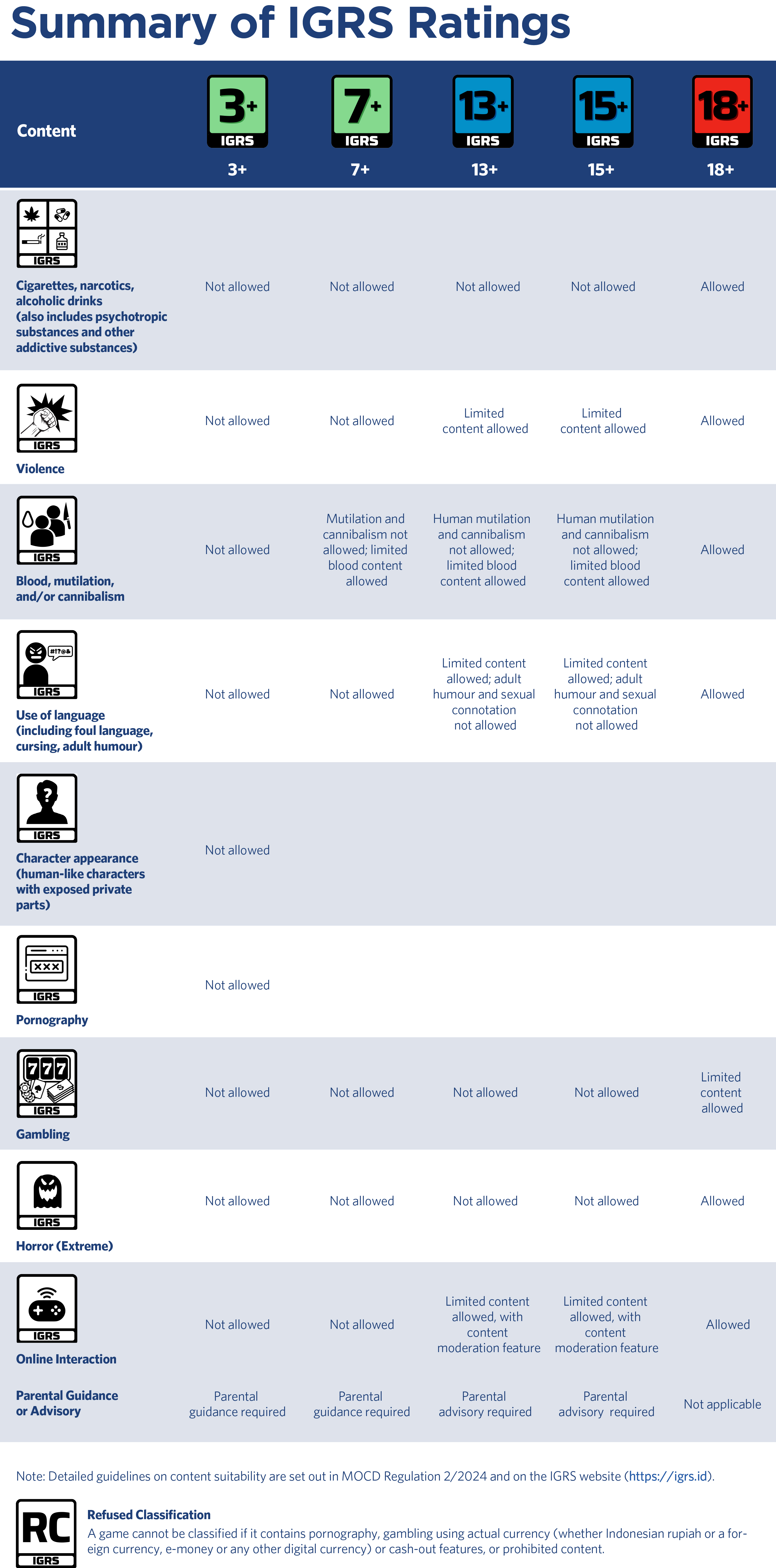
Other Indonesian regulations relevant to content suitability should also be taken into account when developing, publishing and marketing games in Indonesia, including the following:
Two years after the issuance of PR 19/2024, Indonesia’s regulatory framework for the game industry remains open to new business actors. Industry players should, however, monitor implementation of other upcoming key features introduced by PR 19/2024 such as local partnership obligations and local content requirements, as they will influence how foreign businesses can enter and operate in the Indonesian game industry.
The recent rollout of the IGRS rating system, combined with various content suitability regulations, may present challenges for game developers and publishers in Indonesia as they endeavour to comply.
With multiple regulations to consider in preparing a compliance strategy, consistent application of the IGRS ratings should benefit Indonesia’s game industry in the longer term, ensuring greater clarity and standardisation.
Existing business players should level up to comply with the new rules under the IGRS framework and GR 17/2025. Meanwhile, new market entrants can take advantage of an accessible Indonesian game industry while staying alert for any policy updates that change the game industry rules.
(Trainee Kenley Wijaya assisted the authors in preparing this article.)

Partner

Partner, Herbert Smith Freehills Kramer Prolegis Alliance

Senior Associate
Receive timely insights and briefings from HSF Kramer, tailored to keep you informed and ahead